The Complete Guide to
Tender Management Software
Tender Management Software
The complete guide to supplier-side Tender Management Software, including key features, AI, benefits, the tender process and how to choose the right solution.
Contents
- Introduction
- What is Tender Management Software?
- Buyer-side vs Supplier-side Tender Management Software
- Understanding the Difference Between Tender Management Software and RFP Software
- External Drivers Shaping Tender Management
- Organisations Have Outgrown Traditional Ways of Managing Tenders
- Common Tender Management Challenges
- Supporting Regional and Global Tender Operations
- Who Uses Tender Management Software?
- The Complete Tender Management Process: From Strategy to Contract Success
- Key Features of Modern Tender Management Software
- Intelligence-Driven Tender Management
- How AI is Transforming Tender Management
- The Business Benefits of Tender Management Software
- Choosing the Right Tender Management Software
- How TenderEyes Supports Modern Tender Management
- Frequently Asked Questions
1. Introduction
Winning contracts has never been more challenging. Organisations face increasingly competitive markets, more complex tender processes and growing volumes of information, stakeholders and regulatory requirements. Buyers also expect greater transparency, stronger governance, evidence-based responses and clearer demonstrations of value.
At the same time, supplier-side Tender Management Software, also commonly referred to as Bid Management Software, has evolved beyond managing documents and bid responses into a strategic business platform supporting the complete tender journey. Modern solutions bring together market intelligence, organisational knowledge, workflow, operational data and Artificial Intelligence (AI) to improve decision-making, collaboration and tender performance.
This guide explores how modern Tender Management Software supports the complete tender journey, the capabilities and intelligence behind high-performing tender operations, the growing role of AI, and the operational, commercial and strategic benefits organisations can achieve.
Whether you are reviewing current tender management practices, evaluating new software or looking to improve bidding performance, it provides practical guidance to help you make better decisions and ultimately win more of the right contracts.
2. What is Tender Management Software?
Tender Management Software, also referred to as Bid Management Software, is a specialised digital platform that helps vendor and supplier organisations manage and improve their tendering activities across the complete tender journey.
It supports organisations from bid strategy and opportunity planning through qualification, bid preparation and submission to contract management, performance review and continuous improvement.
Modern Tender Management Software brings people, processes, workflows, organisational knowledge and business data together within a structured environment, helping organisations improve collaboration, strengthen governance, reduce risk and deliver higher-quality tender submissions and contracts.
Tender Management Software enables organisations to:
- Develop bidding strategies aligned with business objectives and growth priorities
- Identify and prioritise opportunities using Market Intelligence and Contract Notices & Awards data
- Qualify opportunities and make informed bid/no-bid decisions
- Coordinate bid activities, resources, contributors and workflows
- Create stronger, consistent and compliant submissions using trusted Organisational Knowledge
- Manage governance, reviews, approvals and submissions
- Manage contract delivery, performance, renewals and future opportunities
- Analyse performance and continuously improve bidding success.
The latest generation of Tender Management Software therefore goes beyond managing documents, deadlines and bid responses. It provides an enterprise platform for managing and improving tender performance across the complete lifecycle.
The term Tender Management Software is also sometimes used to describe buyer-side solutions for organisations issuing and evaluating tenders. These solutions serve a different purpose and user group. The following section explains this distinction, before exploring how supplier-side Tender Management Software also differs from more specialised RFP Response Software.
3. Buyer-side vs Supplier-side Tender Management Software
One of the biggest sources of confusion when researching Tender Management Software is that the term is sometimes also used to describe buyer-side solutions.
A distinction is sometimes made between Tender Management Software as a buyer-side term and Bid Management Software as a supplier-side term. However, terminology is not standardised across the market. Tender Management Software is increasingly used to describe supplier-side platforms, while Bid Management Software remains a widely used term for software supporting organisations bidding for contracts.
Rather than relying on terminology alone, it is therefore important to understand which side of the tendering process a solution is designed to support.
Although both types of software are involved in the tendering process, they operate on opposite sides of it. Buyer-side solutions help organisations issue and evaluate tenders, while supplier-side solutions help organisations identify, pursue and win tender opportunities.
Comparison of Buyer-side and Supplier-side Tender Management Software
| Buyer-side Tender Management Software | Supplier-side Tender Management Software |
|---|---|
|
|
|
|
|
|
|
|
|
|
This guide focuses specifically on supplier-side Tender Management Software and how organisations use it to manage and improve performance across the complete tender journey.
4. Understanding the Difference Between Tender Management Software and RFP Software
The terms Tender Management Software and RFP Software are often used interchangeably, but they describe different categories of software. Both help organisations respond to tenders and Request for Proposal (RFPs), but their scope and primary purpose differ.
RFP Software, including platforms such as Loopio, Responsive, Altura and AutoRFP.ai, focuses primarily on response management, while Tender Management Software supports the broader tender journey.
Comparison of RFP Software and Tender Management Software
| RFP Software | Tender Management Software |
|---|---|
|
|
|
|
|
|
|
|
|
|
For organisations managing relatively straightforward response requirements, RFP Software may provide all the functionality they need. Neither approach is inherently better; the right solution depends on an organisation’s objectives, bidding maturity and the complexity of its tender operations.
For organisations managing tendering as a broader strategic business function, Tender Management Software provides the capabilities to connect decisions, activities and performance across the Connected Tender Journey.
5. External Drivers Shaping Tender Management
Tendering has become significantly more competitive, regulated and strategically important. Organisations must identify the right opportunities, meet increasingly complex buyer requirements, demonstrate compliance with evolving legislation and deliver high-quality submissions within demanding timescales.
14% of EU GDP
Public procurement represents more than €3 trillion in annual expenditure across the EU.
Source: European Parliament
Buyer expectations have also evolved, with greater emphasis on governance, transparency, sustainability, value for money and long-term supplier performance. Tender responses therefore increasingly require evidence and expertise from multiple business functions across the organisation.
For organisations operating in regulated industries such as MedTech, life sciences, healthcare, insurance, financial services, engineering, defence and outsourced services, the challenge is even greater. Teams must navigate an expanding range of procurement legislation, industry regulations and customer-specific requirements while maintaining accuracy, consistency and governance throughout the tender process.
Examples include:
- UK Procurement Act 2023 and evolving public procurement legislation.
- Medical Device Regulation (MDR), In Vitro Diagnostic Regulation (IVDR), UKCA, CE marking and EU Authorised Representative (EU REP) requirements.
- Environmental, Social and Governance (ESG), Carbon Reduction Plans (CRP), Social Value and sustainability requirements.
- Cyber security, information governance, quality management and data protection requirements.
- Equality, Diversity and Inclusion (EDI), Modern Slavery, Business Continuity, Corporate Social Responsibility (CSR) and customer-specific compliance requirements.
Modern tenders are also becoming broader in scope. Alongside technical capability, pricing and product information, buyers increasingly expect evidence of operational resilience, supply chain security, sustainability, social value and wider corporate credentials.
Winning contracts therefore depends on more than producing a compliant bid. Organisations need to identify the right opportunities, understand competitive markets and coordinate expertise across the business to make better decisions throughout the tender process.
Managing these requirements across multiple tenders, products, countries and business units requires a more structured approach to governance, information, evidence and approvals.
6. Organisations Have Outgrown Traditional Ways of Managing Tenders
The way that supplier organisations manage tendering has changed significantly.
Historically, tendering was often managed by individual Bid Managers or small local teams using spreadsheets, email and shared document libraries. While this approach may have been sufficient for lower bid volumes, it struggles to support today’s more complex enterprise tender operations.
Many organisations now manage tender activity across multiple business units, countries and regions involving larger product portfolios, growing volumes of content and contributors from multiple business disciplines.
As organisations grow, they need greater bidding visibility and coordination, alongside more consistent processes and governance. They also need to share organisational knowledge and best practice across the business while supporting local market and regulatory requirements.
Organisations are also expected to:
- Develop bidding strategies aligned with wider business objectives
- Monitor Contract Notices & Awards, market trends and competitor activity
- Make consistent, evidence-based bid/no-bid decisions
- Reuse trusted organisational knowledge across the business
- Maintain governance, approvals and auditability throughout the tender journey
- Measure performance, capture lessons learned and continuously improve bidding success.
Tender management has therefore evolved from an operational activity focused primarily on individual bid submissions into a strategic business capability supporting planning, decision-making, governance, enterprise-wide tender operations and continuous improvement.
As the role of tender management has expanded, so too have the capabilities organisations need to perform it successfully.
7. Common Tender Management Challenges
As discussed above, tendering has become increasingly complex. Organisations are managing more opportunities, larger volumes of information, greater regulatory and governance requirements and contributions from multiple teams, business functions and locations.
While the specific challenges vary, several common issues can limit efficiency, bid quality and overall tender performance.
Operational Inefficiency
Tender teams often spend significant time on repetitive administration rather than activities that directly improve bid quality and competitiveness.
Common challenges include:
- Duplicated data entry and repetitive manual activities
- Managing bids through disconnected spreadsheets, emails and shared drives
- Delays caused by handovers, responsibilities and approval processes
- Valuable Bid Team and Subject Matter Expert time being consumed by administration.
Limited Tender Visibility
Without a consistent view of tender activity, organisations can struggle to understand what is happening across their wider bidding operation and make informed decisions about priorities and resources.
Common challenges include:
- Limited visibility of current and future tender opportunities and pipeline
- Poor visibility of bid progress, deadlines, risks and dependencies
- Limited understanding of workloads and resource requirements
- Inconsistent reporting across teams, countries and business units.
Poor Opportunity Selection
Without sufficient Market Intelligence and consistent qualification, organisations risk committing valuable resources to opportunities with limited strategic or commercial value or a low probability of success.
Common challenges include:
- Limited understanding of future opportunities, customers and competitors
- Reactive rather than strategic opportunity selection
- Inconsistent or subjective bid/no-bid decisions
- Pursuing opportunities that do not align with strategic, commercial or operational priorities.
Fragmented Knowledge & Content
Tender knowledge is often spread across previous submissions, shared drives, business systems, individuals and different teams or locations, making the right information difficult to find and reuse.
Common challenges include:
- Difficulty finding trusted, approved content and supporting evidence
- Recreating responses and information that already exist
- Using outdated, inconsistent or unapproved information
- Valuable knowledge, successful responses and lessons learned not being captured and reused.
Collaboration & Communication
Successful tenders require input from multiple teams and Subject Matter Experts. Without clear responsibilities and structured collaboration, coordinating contributors can create delays and inconsistencies.
Common challenges include:
- Unclear ownership of questions, actions and approvals
- Delays obtaining input from Subject Matter Experts and reviewers
- Contributors working across different documents, versions and information sources
- Limited visibility of progress, outstanding actions and responsibilities.
Governance, Security & Compliance
Tendering involves commercial, contractual, regulatory and customer requirements alongside sensitive organisational and customer information. Inconsistent governance can expose organisations to unnecessary risk.
Common challenges include:
- Inconsistent review and approval processes
- Poor document, version and access control
- Limited auditability of decisions, changes and approvals
- Difficulty maintaining regulatory, customer and organisational compliance.
Inconsistent Bid Quality
Even experienced teams can struggle to produce consistently high-quality submissions when time is limited, information is difficult to access or review processes are inconsistent.
Common challenges include:
- Limited access to buyer requirements, evaluation criteria and supporting evidence
- Insufficient time to review and strengthen responses
- Inconsistent quality across contributors, teams and regions
- Responses failing to fully address buyer priorities or maximise available scores.
Contract Delivery & Handover Gaps
Winning the tender is only the start of delivering a successful contract. Poor handover between bid and delivery teams can result in important commitments, documents and customer requirements being difficult to track once the contract begins.
Common challenges include:
- Poor handover of commitments, requirements and information from bid to contract delivery
- Contract documents, obligations and key information being stored across multiple locations
- Limited visibility of contract milestones, performance, renewals and extensions
- Contract experience and customer feedback not feeding into future tender opportunities.
Limited Performance Learning
Every tender and contract provides insight that can improve future performance, but this information is often fragmented or lost once the immediate activity is complete.
Common challenges include:
- Evaluation scores, buyer feedback and lessons learned not being consistently captured
- Limited analysis of wins, losses and qualification decisions
- Contract performance and customer outcomes not informing future bidding strategies
- Successful approaches and best practice not being systematically identified and reused.
Organisations rarely experience these challenges in isolation. Operational inefficiency reduces the time available to improve responses; fragmented knowledge affects bid quality; poor visibility weakens decision-making; and limited performance learning allows the same problems to be repeated.
Addressing these challenges requires more than improving individual bids. It requires the capabilities, processes, knowledge, governance and intelligence to continuously strengthen tender performance across the organisation.
8. Supporting Regional and Global Tender Operations
As organisations grow, tender management often evolves from a series of independent local activities into a coordinated regional or global business function.
Increasing bid volumes, expanding product portfolios, acquisitions and international operations all increase the need for greater consistency, governance, visibility and collaboration across the organisation.
While local teams remain responsible for country-specific procurement processes, customer requirements, languages and regulatory obligations, regional and global teams require greater visibility, coordination and strategic oversight across the wider business.
This shift enables organisations to move beyond isolated country or business unit bid teams and create a connected enterprise tender operation that shares knowledge, standardises best practice and continuously improves performance across the organisation.
TenderEyes Experience
Successful regional and global tender transformation is not about imposing identical ways of working everywhere. It is about establishing consistent processes, governance and shared knowledge across the organisation while retaining the flexibility needed to support different markets, teams and local requirements.
Modern Tender Management Software supports this connected operating model by enabling organisations to:
- Standardise tender processes
- Share knowledge, best practice and successful responses
- Reuse approved content, technical information and supporting evidence
- Maintain consistent governance, security and approvals
- Improve visibility of pipelines, bid performance, resources and contract activity
- Analyse market intelligence, competitor activity and bidding performance across markets
- Benchmark performance across countries and business units
- Provide leadership with consistent reporting and strategic insight.
This enables organisations to balance local expertise and flexibility with consistent enterprise-wide standards, governance, visibility and control.
9. Who Uses Tender Management Software?
Modern Tender Management Software supports four broad groups across the organisation, each requiring different capabilities, information and insight.
Operational Delivery
Focused on managing opportunities, bids, knowledge and contracts efficiently.
- Bid Managers & Tender Excellence Teams: Plan and coordinate bids, manage contributors and improve collaboration, governance, knowledge access and response quality
- Technical & Subject Matter Experts: Access and contribute trusted Organisational Knowledge more easily, reducing duplicated effort and improving response consistency
- Contract Delivery, Customer Success & Account Management: Manage contract commitments, performance, customer feedback, renewals and account growth opportunities.
Strategic Planning & Performance
Focused on using market and performance insight to improve strategy, opportunity selection and results.
- Business Development & Sales: Identify and qualify opportunities, develop bidding strategies and use Market Intelligence to support targeting, forecasting and bid/no-bid decisions
- Market Access, Commercial Excellence & Business Intelligence: Analyse markets, competitors and performance to identify growth opportunities and support evidence-based planning
- Commercial Operations & Regional Management: Gain visibility across countries, business units and product portfolios to improve resource planning, governance and operational consistency
- Marketing: Use market, customer and competitor insights to strengthen positioning, value propositions and supporting tender content.
Enterprise Management & Governance
Focused on maintaining secure, governed, integrated and scalable tender operations.
- Commercial, Finance, Legal, Regulatory & Quality: Manage pricing, risk, compliance, approvals and governance with better access to trusted information and audit trails
- IT & Digital Transformation: Support secure, scalable and integrated tender operations with appropriate data governance and enterprise-wide controls.
Executive Strategy & Leadership
Focused on using business-wide insight to support strategic planning, investment and long-term performance.
- Executive Leadership: Gain consolidated visibility of opportunities, pipeline, bidding performance, resources and commercial outcomes to support strategic decision-making.
Tender Management Across Different Industries
Tender Management Software is used across industries where winning contracts depends on coordinating complex bids, multiple contributors, specialist knowledge and strong governance. Typical sectors include:
- MedTech, Life Sciences & Healthcare
- Managed & Outsourced Services
- Facilities Management
- Defence & Security
- Transport & Infrastructure
- Financial Services & Insurance
- Logistics & Supply Chain.
Requirements vary by industry. Highly regulated sectors such as MedTech, Life Sciences and Financial Services may place greater emphasis on regulatory compliance, governance and approved technical information. Engineering, Facilities Management and Outsourced Services may involve complex operational, commercial and service delivery requirements.
The underlying need remains the same: bringing together the people, knowledge, processes and intelligence required to pursue and deliver contracts successfully.
10. The Complete Tender Management Process: From Strategy to Contract Success
Tender success is built over a series of connected stages rather than a single bid submission. Every decision, from developing bidding strategies and selecting the right opportunities through to delivering contracts and reviewing performance, influences future success.
The challenges outlined earlier are often compounded when these stages are managed separately across different teams, systems and business functions.
High-performing organisations instead manage tendering as one Connected Tender Journey, enabling information, knowledge and insight to flow between each stage and inform the next.
Modern Tender Management Software provides the foundation for this connected approach by bringing together people, processes, workflows and information within a single enterprise platform, improving visibility, collaboration and control across the complete tender journey.
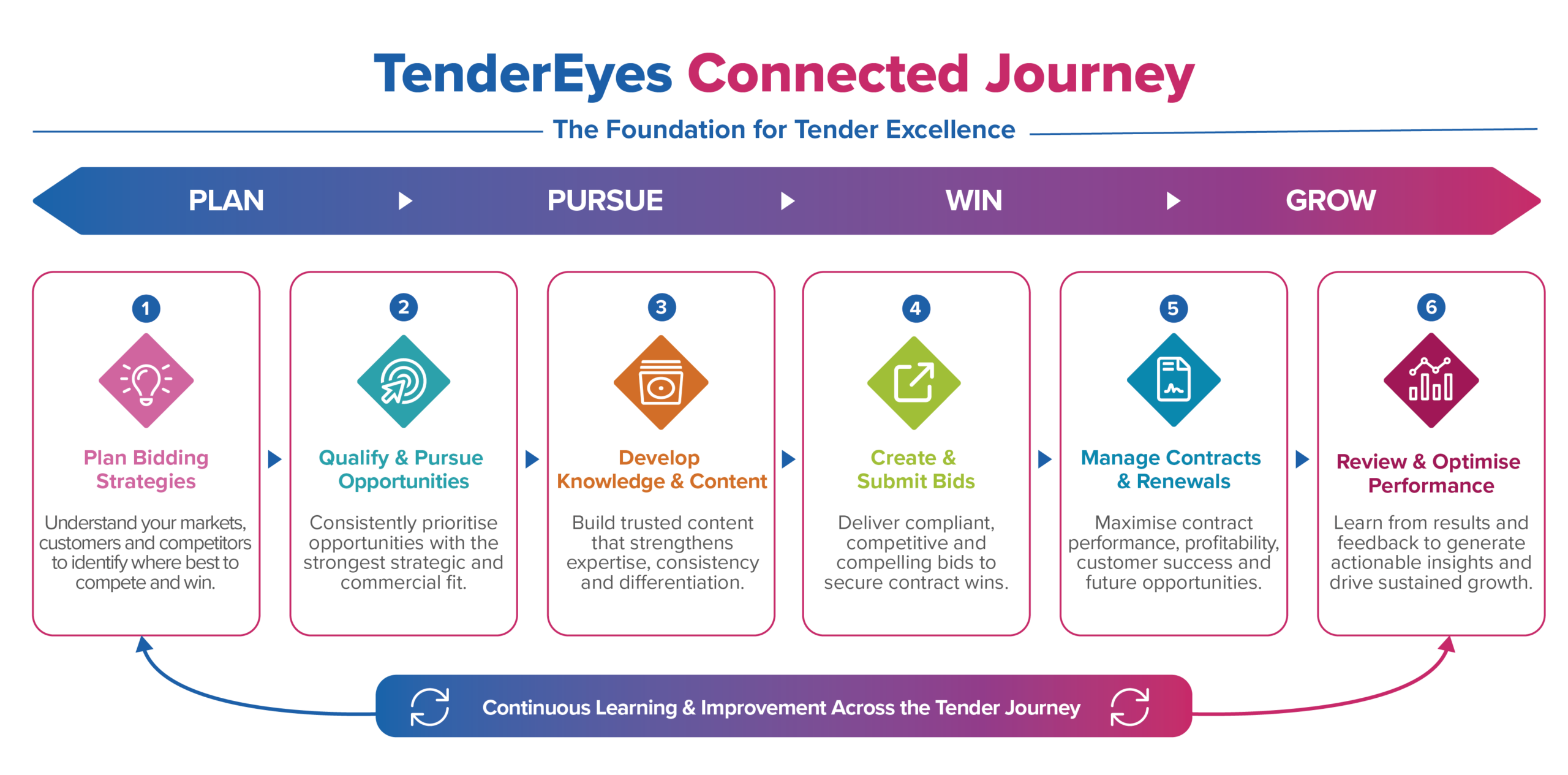
The six stages below illustrate how high-performing organisations manage the complete tender journey, with each stage building on the previous one to create a continuous cycle of planning, delivery, learning and improvement.
1. Plan Bidding Strategies
Successful tendering begins long before a contract opportunity is published. Organisations must understand their strategic objectives, target markets and growth priorities to ensure bidding activity supports wider business goals.
Typical activities include:
- Defining target markets, customers and tender priorities
- Monitoring Contract Notices & Awards, market trends and competitor activity
- Analysing competitor performance and identifying market gaps
- Building a healthy pipeline of future opportunities.
2. Qualify & Pursue Opportunities
Not every opportunity is worth pursuing. Effective qualification ensures resources are focused on opportunities that offer the strongest strategic, operational and commercial fit.
Typical activities include:
- Identifying relevant contract opportunities
- Matching opportunities to organisational capabilities
- Assessing strategic, commercial and operational fit
- Making structured, evidence-based bid/no-bid decisions.
3. Develop Knowledge & Content
Successful tendering depends on teams having access to accurate, trusted and relevant Organisational Knowledge. Effective knowledge management enables organisations to capture, maintain, share and reuse valuable information rather than repeatedly recreating it.
Typical activities include:
- Capturing and maintaining approved tender content
- Managing product, service and technical information
- Organising case studies, evidence and supporting documentation
- Sharing and reusing trusted knowledge and best practice across the organisation.
4. Create & Submit Bids
Once an opportunity has been approved, teams need to plan and coordinate the bid, develop high-quality responses and manage the submission through review, approval and final delivery.
Typical activities include:
- Creating bid plans, timelines and responsibilities
- Coordinating contributors, questions, requirements and supporting information
- Developing high-quality, compliant and customer-focused responses
- Managing reviews, approvals, document control and final submission.
5. Manage Contracts & Renewals
Winning a contract is not the end of the tender journey. Organisations need to manage contractual commitments and performance while capturing information that supports customer success, renewals and future opportunities.
Typical activities include:
- Recording contract information, obligations and commitments
- Managing milestones, deliverables and contract performance
- Monitoring customer performance and feedback
- Managing renewals, extensions and future opportunities.
6. Review & Optimise Performance
Every tender and contract generates valuable insight. Reviewing performance enables organisations to understand what worked, what did not and where improvements can strengthen future tender activity.
Typical activities include:
- Analysing bid performance, evaluation scores and win rates
- Reviewing qualification decisions, resources and operational performance
- Analysing customer feedback and contract outcomes
- Capturing lessons learned and strengthening future tender performance.
How Tender Management Software Adds Value Across the Tender Journey
The six stages create value in different but connected ways:
| Tender Stage | Business Value Delivered |
|---|---|
|
|
|
|
|
|
|
|
|
|
|
|
Managing the tender lifecycle as one Connected Tender Journey enables information, knowledge and insight generated at each stage to strengthen future decisions and performance, creating a continuous cycle of improvement.
11. Key Features of Modern Tender Management Software
Over the past 15 years, we’ve worked with organisations ranging from specialist bid teams to global enterprises managing complex tender operations across multiple countries.
While every organisation is different, high-performing tender organisations consistently demonstrate capabilities that extend beyond producing high-quality bid responses. These capabilities span strategic planning, operational excellence, governance, intelligence and continuous improvement.
We refer to this as the Tender Excellence Framework: 12 Capabilities for a smarter, intelligence-driven tender operation.
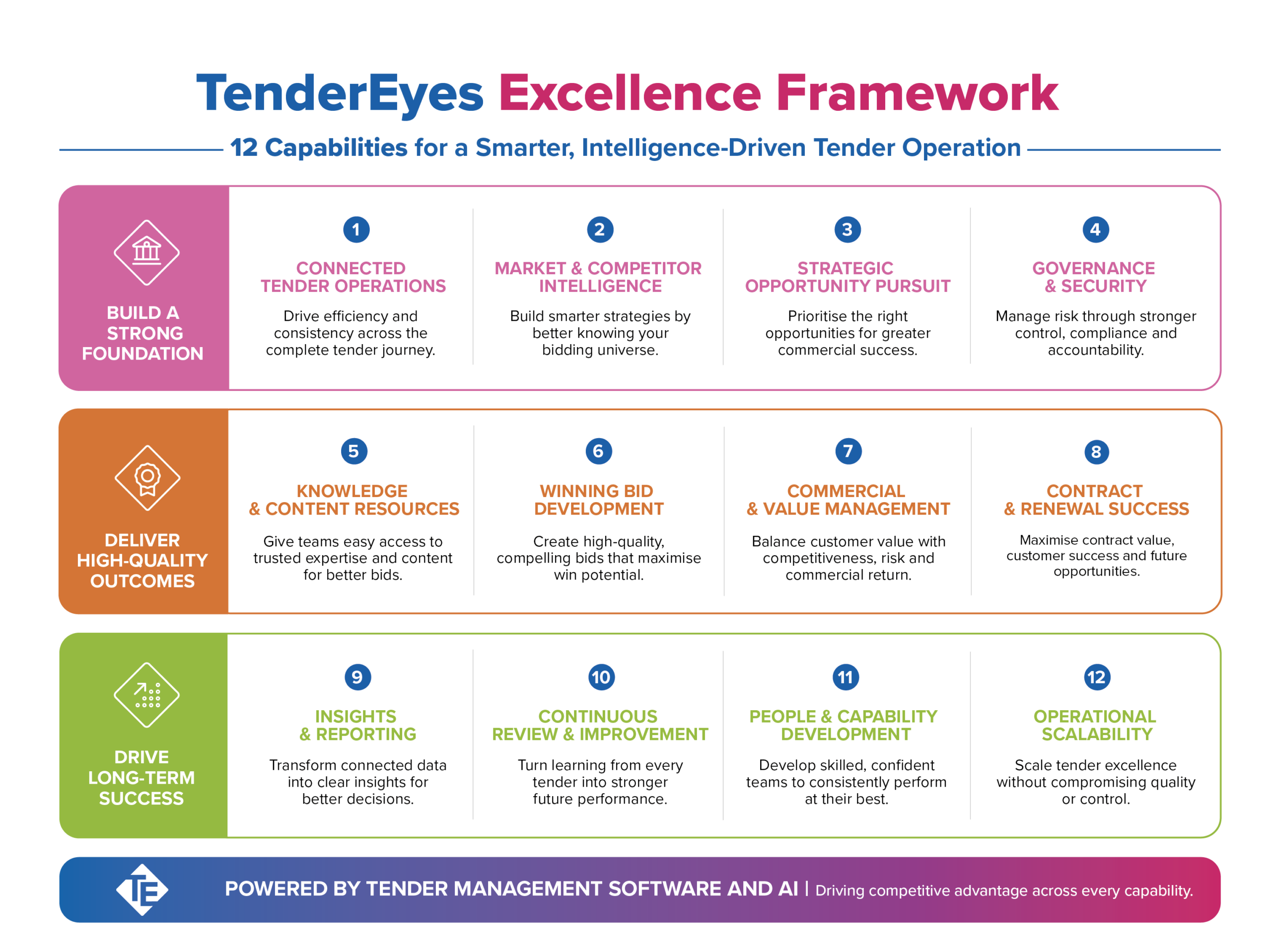
Build a Strong Foundation
Connected Tender Operations
Streamline tender operations through automated workflows, connected business systems and consistent processes, with clear visibility across activities, resources and deadlines.
Typical capabilities include:
- Project, task and resource management
- Workflow automation, milestones and notifications
- Operational dashboards, reporting and business system integration.
Market & Competitor Intelligence
Develop a clear understanding of your bidding universe across markets, customers, competitors and opportunities to support better strategic decisions.
Typical capabilities include:
- Market Intelligence and Contract Notices & Awards data
- Competitor, customer and market analysis
- Opportunity discovery, monitoring and pipeline visibility.
Strategic Opportunity Pursuit
Apply consistent qualification and assessment to prioritise opportunities with the strongest strategic, commercial and operational fit, focusing resources where they can deliver the greatest value.
Typical capabilities include:
- Opportunity management and structured qualification
- Bid/no-bid scoring, risk and commercial assessment
- Decision and approval workflows.
Governance & Security
Maintain control, accountability and compliance through robust governance while protecting sensitive tender, customer and commercial information.
Typical capabilities include:
- Review, approval and compliance workflows
- Audit trails, version history and document control
- Role-based permissions and enterprise security.
Deliver Tender Excellence
Knowledge & Content Resources
Establish accurate, current and approved organisational knowledge and content that improves consistency, response quality and confidence across tender submissions.
Typical capabilities include:
- Central knowledge bank and approved reusable content
- Product, commercial, case study and supporting information
- Content ownership, version control and intelligent retrieval.
Winning Bid Development
Plan and coordinate every bid from kick-off to submission, ensuring contributions, reviews and approvals are completed on time and to the required quality
Typical capabilities include:
- Shared bid workspaces and team collaboration
- Question, requirement and task management
- Collaborative response development, review and quality assurance.
Commercial & Value Management
Develop commercially strong tender propositions that balance customer value, competitiveness, risk and return.
Typical capabilities include:
- Pricing, commercial modelling and value proposition development
- Commercial risk, assumptions and contractual requirement assessment
- Customer value, benefits and commercial case development.
Contract & Renewal Success
Manage contractual commitments, monitor delivery and maintain continuity after award to support customer success, renewals, rebids and future commercial opportunities.
Typical capabilities include:
- Contract repository, obligations and milestone management
- Contract and customer performance monitoring
- Renewals, extensions, dashboards and reporting.
Drive Long-Term Success
Insights & Reporting
Measure and analyse tender activity, performance and results across teams, regions and countries to identify trends, benchmark performance and support better decisions.
Typical capabilities include:
- Win/loss, qualification and evaluation score analysis
- KPI, pipeline and resource performance reporting
- Dashboards, trends and performance insights.
Continuous Review & Improvement
Turn lessons, feedback and results into targeted actions that address capability gaps, embed best practice and strengthen future tender performance.
Typical capabilities include:
- Bid and contract reviews and lessons learned
- Improvement actions and best-practice sharing
- Knowledge, content and process improvement.
People & Capability Development
Develop skilled, confident teams with the knowledge, expertise and best practice needed to consistently perform at their best.
Typical capabilities include:
- Tender skills, training and capability development
- Sharing expertise, best practice and successful approaches across teams
- Identifying capability gaps and strengthening future performance.
Operational Scalability
Scale tender operations across growing bid volumes, teams, countries and business units while maintaining consistent processes, quality, governance and control.
Typical capabilities include:
- Multi-country, multi-language and localised deployment
- Flexible user, team and organisational structures
- Enterprise-wide access, permissions and administration.
How Tender Management Software Adds Value Across the Tender Journey
The six stages create value in different but connected ways:
| Tender Stage | Business Value Delivered |
|---|---|
|
|
|
|
|
|
|
|
|
|
|
|
Managing the tender lifecycle as one Connected Tender Journey enables information, knowledge and insight generated at each stage to strengthen future decisions and performance, creating a continuous cycle of improvement.
12. Intelligence-Driven Tender Management
For many years, Tender Management Software focused primarily on helping organisations manage projects, documents and bid responses more efficiently.
While these capabilities remain important, organisations increasingly need the data, knowledge and insight to make better decisions before, during and after every tender.
Intelligence-Driven Tender Management brings together data and knowledge from across the market, organisation, tender operation and performance outcomes to improve strategic planning, operational delivery and tender performance.
Rather than treating every tender as an isolated project, organisations can use this intelligence to learn from the wider market, their own knowledge and every tender and contract they manage.
We refer to this as Better Know Your Bidding Universe, bringing data and knowledge from multiple sources into the tender operation to build a more complete picture of the bidding environment.
Four key sources underpin this approach, as shown below.
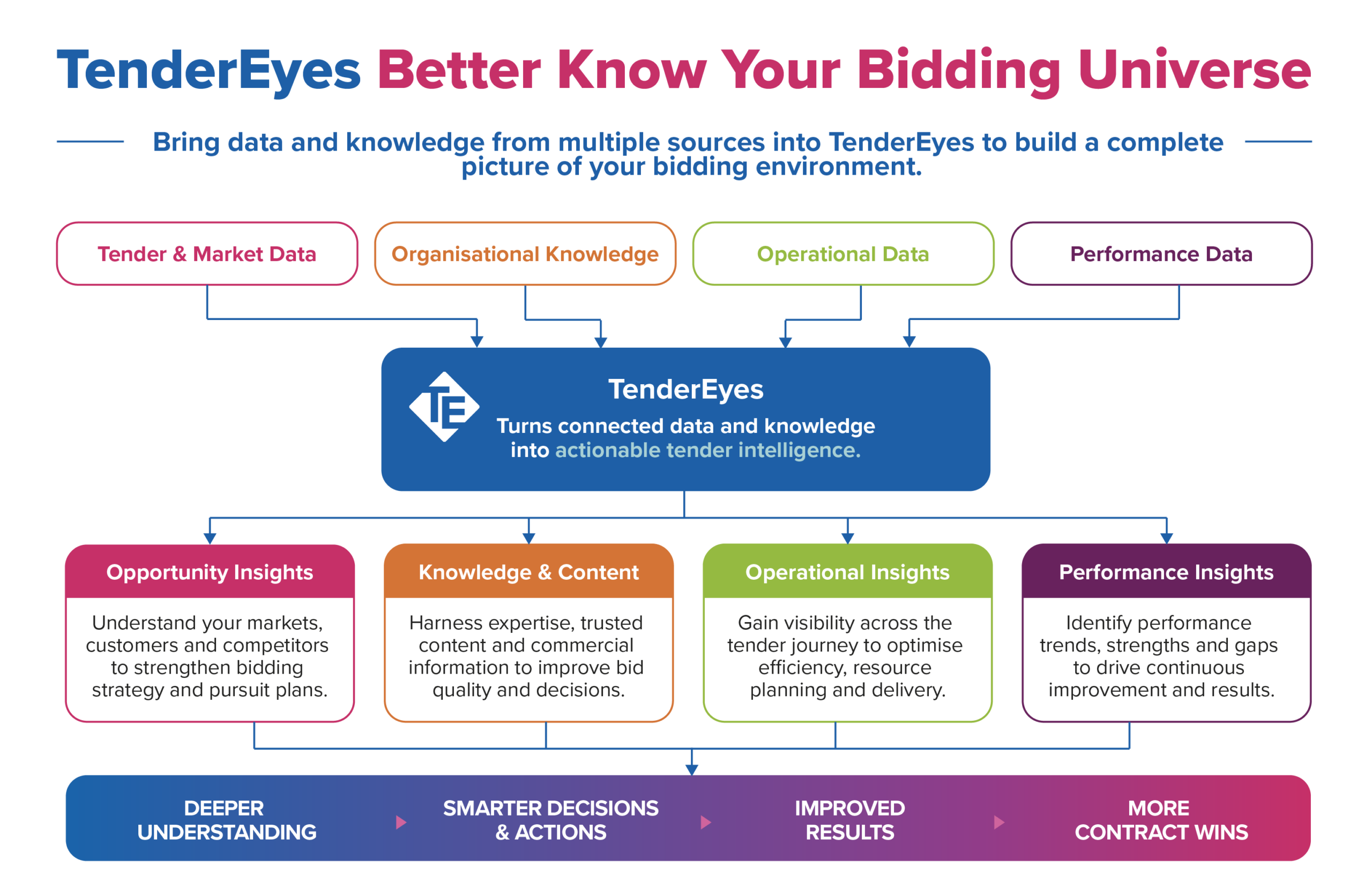
Tender & Market Data
Tender and Market Data provides visibility of the markets, customers, competitors and opportunities that shape an organisation’s bidding environment.
Examples include:
- Contract Notices & Awards data
- Customer and buyer activity
- Competitor activity and contract awards
- Market trends and emerging opportunities
- Contract values, durations and renewal cycles
- Geographic, sector and product market activity.
When analysed collectively, this data creates Market Intelligence that helps organisations understand their external market, identify growth opportunities and make more informed strategic and pursuit decisions.
Organisational Knowledge
Organisations build valuable knowledge through previous tenders, customer relationships, product expertise and contract delivery. Bringing this together provides a trusted source of information that can be accessed and reused throughout the tender journey.
Examples include:
- Previous tenders and approved responses
- Product, service and technical information
- Pricing and commercial data
- Customer and sales insight
- Policies, accreditations, evidence and case studies
- Subject Matter Expert knowledge and best practice.
This creates Organisational Knowledge that helps teams make informed decisions and develop accurate, consistent and compelling tender responses.
Operational Data (Understanding How You Operate)
Every tender generates data about how work is being managed. Capturing this information provides visibility of tender activity, resources, processes and governance.
Examples include:
- Tender pipelines and bid activity
- Qualification decisions and scores
- Workloads and resource utilisation
- Tasks, milestones and timescales
- Workflow, approvals and review activity
- Governance, risks and process bottlenecks.
This creates Operational Intelligence that helps organisations understand how effectively tender operations are working, identify problems earlier and improve resources, governance and delivery.
Performance Data (Understanding What Drives Success)
Tender and contract outcomes provide valuable evidence of what drives success. Analysing performance over time helps organisations identify what works, what does not and where improvements will have the greatest impact.
Examples include:
- Bid win/loss results
- Evaluation scores and buyer feedback
- Qualification and pursuit success rates
- Response and review performance
- Contract performance, renewals and extensions
- Performance trends and lessons learned.
This creates Performance Intelligence that helps organisations identify success factors, benchmark performance and continuously improve future bidding strategies and processes.
Turning Data and Knowledge into Actionable Intelligence
The greatest value comes from connecting Market Intelligence, Organisational Knowledge, Operational Intelligence and Performance Intelligence rather than using them in isolation.
Together, they provide a more complete view of of your bidding universe; where to compete, how to operate effectively and what drives success, enabling better strategic, operational and commercial decisions throughout the tender journey.
Artificial Intelligence can further enhance this process by analysing large volumes of data and knowledge, identifying patterns and relationships, surfacing relevant information and supporting faster decision-making.
The next section explores how AI can be applied across the tender journey and why trusted data, governance and human expertise remain critical to its effective use
13. How AI is Transforming Tender Management
Artificial Intelligence (AI) is rapidly changing the way organisations manage tenders. While much of the market has focused on AI-generated bid responses, its potential extends far beyond content generation.
When applied to trusted organisational knowledge and market, operational and performance data, AI can analyse large volumes of information quickly, automate repetitive activities and provide insight that would be difficult or time-consuming to identify manually.
This enables tender professionals to spend less time searching, analysing and administering information and more time on strategic thinking, customer engagement and improving bid quality.
How AI Improves Tender Management
AI can make tender management faster, more consistent and more intelligent by helping organisations:
- Analyse & Extract: Rapidly analyse tender documents, contracts and large datasets to extract requirements, questions, deadlines, obligations and key information
- Find & Match: Match opportunities, questions and requirements to relevant Organisational Knowledge, previous responses, evidence, products and expertise
- Evaluate & Score: Assess opportunities and responses against defined qualification criteria, buyer requirements and evaluation methodologies to support more consistent scoring and decision-making
- Generate & Refine: Create first-draft responses using trusted Organisational Knowledge and help improve accuracy, relevance, consistency and quality
- Compare & Benchmark: Analyse performance across tenders, teams, markets and time periods to identify trends, differences, strengths and improvement opportunities
- Identify & Predict: Detect patterns, risks, gaps and success factors within market, operational and performance data to support better planning and future decisions.
Generic AI vs Enterprise AI
As AI adoption accelerates, employees are increasingly using publicly available AI tools to analyse tender documents, generate responses and summarise information. While this can improve individual productivity, it can also introduce business risks.
Without appropriate governance, teams may use different AI tools, prompts and information sources, increasing the risk of inconsistent outputs and reliance on inaccurate, outdated or unapproved information. Sensitive commercial and customer data may also be exposed outside the organisation’s controlled environment.
AI adoption is accelerating. ONS data showed that by late 2025, 25% of UK businesses were using some form of AI technology, rising to 44% among businesses with 250 or more employees. UK Office for National Statistics
However, governance is not necessarily keeping pace. UK Government research found that only 17% of businesses using AI had a policy or guidelines covering its use and development, with just 5% having a formal written policy. UK Business Data Survey 2026
Enterprise AI embedded within Tender Management Software provides a more controlled approach by applying AI within the organisation’s existing data, knowledge, workflows and governance framework.
This enables organisations to:
- Use trusted Organisational Knowledge and approved information
- Apply consistent governance, workflows and approvals
- Protect confidential commercial and customer information
- Improve transparency and accountability for AI-assisted activities
- Improve the accuracy and consistency of AI-supported outputs
- Adopt AI within a secure enterprise environment.
AI Should Enhance Expertise, Not Replace It
Successful tendering still depends on human expertise, strategic thinking and customer understanding. AI can analyse information, automate repetitive activities and surface relevant insights, but critical commercial, technical and strategic decisions remain in the hands of experienced professionals.
The real opportunity is therefore not simply to generate responses faster. It is to use AI to turn trusted data and knowledge into faster analysis, better decisions, greater efficiency and continuous improvement across the Connected Tender Journey.
14. The Business Benefits of Tender Management Software
Organisations rarely invest in Tender Management Software simply to improve internal processes. They invest because they want to improve business performance.
Whether the objective is increasing bid win rates, achieving higher evaluation scores, protecting market share, expanding into new markets or supporting long-term business growth, the goal is the same: to win more of the right contracts.
Modern Tender Management Software delivers value at three levels: improving day-to-day operations, strengthening commercial performance and supporting strategic growth.
Operational Benefits
Pursue More of the Right Opportunities
Better visibility of market activity, structured qualification and informed bid/no-bid decisions help organisations focus valuable time, expertise and resources on opportunities with the strongest potential for success.
Typical benefits include:
- Greater visibility of market opportunities and Contract Notices & Awards
- Better alignment between bidding activity and business strategy
- More consistent, evidence-based bid/no-bid decisions
- Improved pipeline management, forecasting and return on bid investment.
Improve Productivity and Operational Efficiency
Tender Management Software streamlines workflows, improves collaboration and automates routine activities, enabling bid teams to spend less time managing the process and more time strengthening submissions.
Typical benefits include:
- Reduced administration and repetitive manual activities
- Faster bid preparation and response development
- Improved coordination of tenders, contributors, deadlines and resources
- More time to focus on response quality and competitive differentiation.
Improve Collaboration and Knowledge Sharing
Tender Management Software provides a shared environment where teams can collaborate and access trusted Organisational Knowledge and supporting evidence throughout the bid process.
Typical benefits include:
- Better collaboration across bid teams and business functions
- Easier access to trusted Organisational Knowledge and supporting evidence
- Greater reuse of approved content, product information and case studies
- More consistent responses and better preservation of organisational knowledge.
Strengthen Governance and Reduce Risk
Structured workflows, approvals and auditability help organisations maintain compliance and reduce operational, commercial and contractual risk.
Typical benefits include:
- Stronger governance, accountability and auditability
- Improved compliance with industry, customer and organisational requirements
- Better document, version and approval control
- Reduced operational, commercial and contractual risk.
Commercial Benefits
Achieve Higher Evaluation Scores
Tender Management Software helps teams align responses with buyer requirements and evaluation criteria, identify weaknesses earlier and focus more time on strengthening evidence, differentiation and overall response quality.
Typical benefits include:
- Better visibility of buyer requirements, evaluation criteria and scoring methodologies
- More structured reviews and earlier identification of weaknesses
- More time to strengthen responses, evidence and differentiation
- More compelling responses that maximise available scores.
Increase Bid Win Rates
Higher win rates result from consistently selecting the right opportunities, producing stronger submissions and applying lessons from previous performance.
Typical benefits include:
- Better opportunity selection and qualification
- Stronger, more competitive tender submissions
- Better collaboration and decision-making throughout the bid process
- Fewer errors, omissions and compliance issues.
Customer Experience
Across TenderEyes customer implementations, we have seen improvements in pipeline visibility, process efficiency, SME collaboration and engagement, governance, and contract and performance reporting.
Strategic Benefits
Drive Continuous Improvement
Tender and contract performance data enables organisations to identify what works, where improvements are needed and how future bidding performance can be strengthened.
Typical benefits include:
- Better understanding of bid performance and win/loss trends
- Greater visibility of resource, process and performance issues
- Better capture and reuse of lessons learned and best practice
- Continuous improvement in future bidding strategies and performance.
Support Business Growth
Tender Management Software provides the visibility, governance and scalability needed to support expansion into new markets, products, countries and business units while maintaining consistent standards.
Typical benefits include:
- Consistent tender processes across growing operations
- Greater visibility across countries, regions and business units
- Better executive reporting and strategic decision-making
- Scalable tender operations supporting regional and global growth.
Create Sustainable Competitive Advantage
The greatest benefit of modern Tender Management Software is the cumulative impact of better decisions, stronger collaboration, improved governance, higher-quality submissions and continuous improvement.
Over time, these improvements strengthen market position and commercial performance, supporting sustainable competitive advantage and long-term growth through winning more of the right contracts.
15. Choosing the Right Tender Management Software
Selecting the right Tender Management Software is about more than comparing feature lists. Start with a clear understanding of your organisation’s objectives, requirements and long-term bidding strategy.
The right solution should address your immediate priorities while providing the flexibility, scalability and capabilities to support future growth.
When evaluating potential solutions, consider the following areas.
Start with Your Business Objectives
Before evaluating software, clearly define what success looks like.
Ask questions such as:
- What are we trying to improve?
- What challenges are preventing us from achieving our bidding goals?
- Are we trying to increase win rates, improve evaluation scores or support business growth?
- Which parts of the tender journey require the greatest improvement?
- How will we measure success?
Understanding your objectives helps ensure the software supports your business strategy rather than simply introducing new technology.
Look Beyond Response Management
Many solutions focus primarily on creating tender responses. While this may be sufficient for some organisations, others require broader capabilities across the Connected Tender Journey.
Consider whether the solution supports:
- Planning bidding strategies
- Qualifying and pursuing opportunities
- Managing knowledge and content
- Creating and submitting bids
- Managing contracts and renewals
- Reviewing and optimising performance.
Choose a platform that aligns with both your current needs and the broader capabilities required to build a high-performing tender operation. The 12 capabilities within the Tender Excellence Framework provide a useful structure for assessing requirements across the complete tender journey – from strategy, operations and governance through bid delivery, people development, scalability and continuous improvement.
Evaluate Intelligence and AI
AI is rapidly becoming an important part of modern Tender Management Software, but not all AI capabilities deliver the same value.
Rather than focusing solely on AI-generated responses, consider how the platform uses trusted data, organisational knowledge and AI to support decisions and activities across the tender journey.
Questions to consider include:
- Does it use trusted organisational knowledge?
- Can it analyse tender documents and identify key requirements?
- Does it support opportunity qualification and decision-making?
- Is AI governed within secure business workflows?
- Can it provide meaningful operational and performance insights?
The most valuable AI solutions support better decisions and performance rather than simply generating content.
Assess Flexibility, Integration and Scalability
The solution should be able to integrate with your existing business systems and adapt as your organisation grows, processes change and tender operations expand across products, teams, business units and markets.
Look for:
- Configurable workflows
- Integration with CRM, ERP, Microsoft 365 and other business systems
- Flexible reporting
- Multi-country and multi-business unit support
- Role-based permissions
- Enterprise security.
Also consider whether the platform can accommodate increasing bid volumes, new business units and international growth without significant redevelopment or replacement.
Consider the Vendor, Not Just the Software
Selecting Tender Management Software is also the start of a long-term vendor relationship. A provider with genuine tender management expertise can support implementation, best practice, process improvement and ongoing optimisation.
Consider:
- Experience and tender management expertise
- Customer success stories
- Product roadmap and innovation
- Implementation approach
- Training and customer support
- Long-term commitment to product development.
A Practical Evaluation Checklist
Before making a final decision, ask:
- Does the software support the complete Connected Tender Journey?
- Will it help us achieve our business objectives?
- Can it improve bid quality and increase win rates?
- Does it provide meaningful intelligence rather than simply more data?
- Is AI embedded in a secure, governed and practical way?
- Can it adapt and scale as our organisation grows?
- Do we have confidence in the vendor as a long-term partner?
The right Tender Management Software should support both current requirements and future ambitions, providing a foundation for stronger tender performance and long-term business growth.
16. How TenderEyes Supports Modern Tender Management
TenderEyes has been developed specifically to support organisations managing tendering as a strategic business function, extending beyond the traditional focus on producing bid responses.
Built on over 15 years of specialist tender management expertise, TenderEyes brings together enterprise Tender Management Software, Market Intelligence, Organisational Knowledge, embedded AI, automation and governance within one connected platform.
TenderEyes supports the complete Connected Tender Journey – from planning bidding strategies and pursuing the right opportunities through bid creation and submission to contract delivery, performance analysis and continuous improvement. It combines the data and intelligence needed to better know your bidding universe with the capabilities required to continuously strengthen Tender Excellence.
Key capabilities include:
- Intelligence-Driven Tender Management across the complete tender lifecycle
- Integrated Contract Notices & Awards data and Market Intelligence
- Opportunity identification, qualification and bid/no-bid decision support
- Centralised organisational knowledge and intelligent content management
- Embedded AI supporting analysis, knowledge discovery, response development and decision-making
- Configurable workflows, governance, security and permissions
- Contract management, reporting and continuous performance improvement
- Multi-country deployment with configurable processes and localisation.
Together, these capabilities provide organisations with a connected platform for managing tender activities, information and performance across the complete tender journey.
17. Frequently Asked Questions
Tender Management Software is a specialised digital platform that helps vendor and supplier organisations manage and improve bidding activities across the complete tender journey. This can include bid strategy and opportunity planning, qualification, bid development and submission, contract management, performance analysis and continuous improvement.
The terms Tender Management Software and Bid Management Software are often used interchangeably for supplier-side software. Bid Management Software is commonly associated with managing individual bids and responses, while modern Tender Management Software can support a broader range of activities across the tender lifecycle, including strategy, opportunity management, governance, contract management and performance improvement. However, terminology varies between vendors and markets.
Tender Management Software is widely used to describe supplier-side platforms that help organisations identify, qualify, manage and respond to tender opportunities. However, the term is also sometimes used for buyer-side solutions that help organisations issue tenders, evaluate suppliers and award contracts. It is therefore important to establish which side of the tendering process a particular solution supports.
RFP or RFP Response Software focuses primarily on helping organisations create and manage responses to RFPS (Request for Proposal), tenders and questionnaires. Tender Management Software typically has a broader scope, supporting activities such as bid strategy, opportunity identification and qualification, governance, knowledge management, response development, contract management and continuous improvement.
The tender management process covers the activities involved in planning, pursuing, developing, delivering and learning from tender opportunities. A complete process can include:
- Planning bidding strategies,
- Qualifying and pursuing opportunities
- Managing knowledge and content
- Creating and submitting bids
- Managing contracts and renewals
- Reviewing and optimising performance.
Tender Management Software is used by organisations that regularly compete for public and private sector contracts. Users can include bid and tender managers, sales and commercial teams, marketing, finance, legal, regulatory, quality and other Subject Matter Experts, as well as senior leaders responsible for bidding strategy and performance.
It can support tender operations within individual countries and business units, as well as regional and global teams that need greater consistency, visibility and control across multiple markets.
Key capabilities of a modern Tender Management solution can include Market Intelligence and Contract Notices & Awards data, opportunity management and qualification, workflow and project management, organisational knowledge management, collaborative response development, AI-enabled analysis and content generation, governance and approvals, contract management, reporting and performance analysis. Enterprise platforms can also support integration with existing business systems, governance and security, automation, and scalable multi-country operations.
Tender Management Software can help organisations improve opportunity selection, reduce manual repetitive tasks, strengthen collaboration and governance, make better use of organisational knowledge and produce stronger, more consistent tender submissions. It can also provide greater visibility of tender performance and support continuous improvement across the tender lifecycle.
Yes. AI can support activities throughout the tender journey, including opportunity analysis and qualification, tender document analysis, knowledge retrieval, response development and performance analysis. When embedded within a Tender Management platform, AI can work alongside approved organisational knowledge, processes and governance controls to improve efficiency, consistency and decision-making.
Intelligence-Driven Tender Management combines external market insight, organisational knowledge, operational and performance data and Artificial Intelligence to support better decisions throughout the tender journey. Rather than focusing solely on producing responses, it helps organisations understand their markets, identify and qualify the right opportunities, improve bid delivery and continuously learn from performance.
Software alone cannot guarantee a higher win rate, but it can strengthen many of the factors that influence tender success. Better opportunity selection, stronger collaboration, effective governance and access to trusted organisational knowledge help teams work more efficiently and stay on track against critical deadlines.
Reducing manual administration and time spent finding information also gives teams more time to review and refine responses, improve quality and maximise evaluation scores. Combined with continuous performance analysis and improvement, these factors can contribute to stronger bids and improved long-term win rates.
Organisations need to look beyond individual features and consider how well a solution supports their complete tender journey and wider business objectives. This means assessing requirements holistically across strategy, opportunity management, bid delivery, knowledge, governance, contract management and performance improvement, rather than focusing on individual stages in isolation.
For regional and global organisations, this assessment also needs to consider requirements at country, regional and global levels, balancing local flexibility with greater standardisation, visibility and control across the wider organisation.
Key considerations include functionality, AI and intelligence capabilities, integration with existing business systems, security, configuration, scalability and the ability to support changing requirements and future growth.
Yes. Enterprise Tender Management Software can integrate with existing business systems such as CRM, ERP, Microsoft 365, document management platforms and business intelligence tools. Integration can reduce duplicate data entry, improve information sharing and create more connected processes across sales, commercial, finance and tender teams.
See TenderEyes in Action
Discover how TenderEyes connects intelligence, AI and your complete tender journey to improve efficiency, strengthen bid quality and drive more contract wins.
Not ready for a demo? Then why not take the 5-minute Tender Management Health Check to identify where operational challenges may exist across your tender journey.